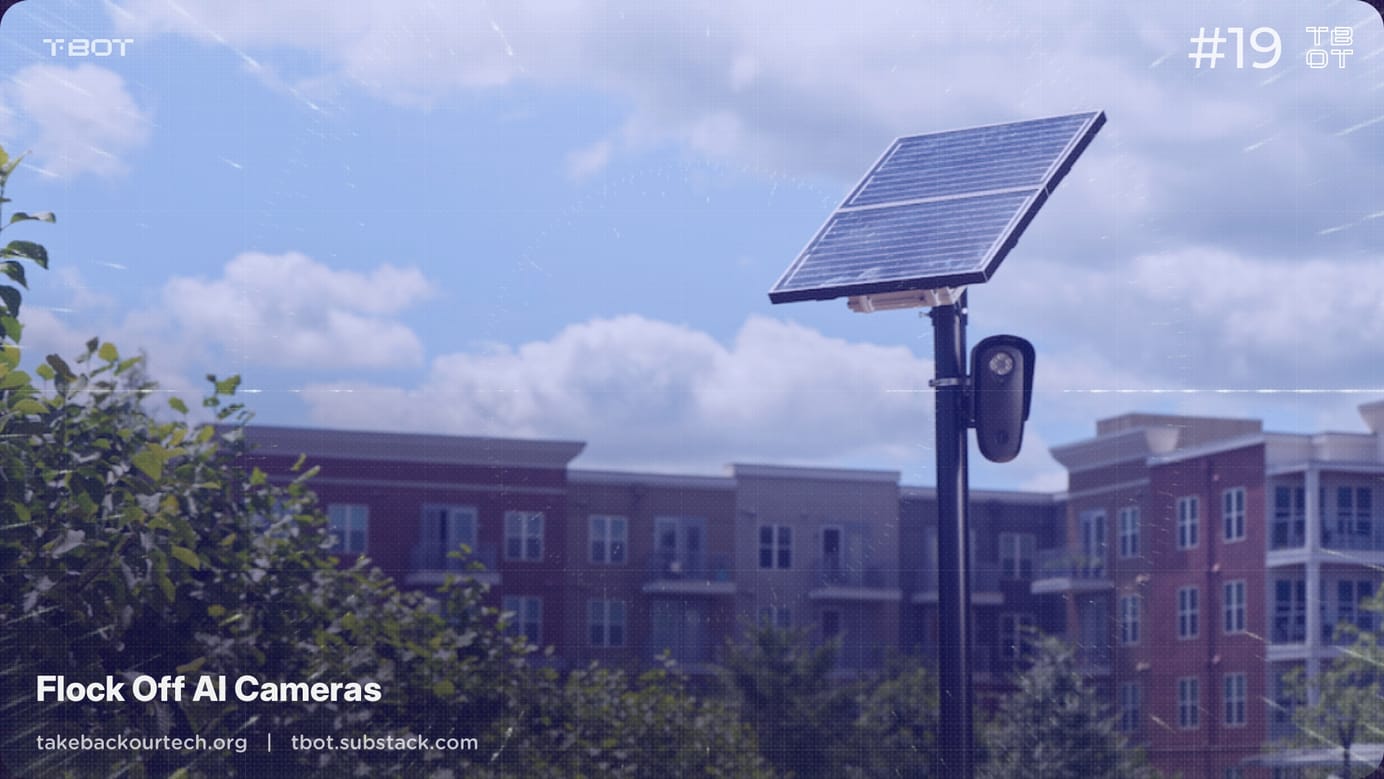
Flock Off AI Cameras!
What if your car could be pinpointed on the road in near-real time?

Flock Safety has partnered with hundreds of police departments in the United States, turning dystopian surveillance into a commercial product.
You’ve likely already seen these black teardrop shaped cameras popping up in your town—and after this article you’ll know exactly how they work and how to push back.
What is Flock?
Flock Safety builds automated license plate readers (ALPRs) that capture every vehicle that drives past them. But they read far more than just license plates—they record a whole suite of identifying features like make, model, color, sticker location, even the angle of the windshield.
- Data volume: Millions of vehicle reads are logged every single day.
- Who gets the data: Police departments can pull the information without a warrant—no judge, no probable‑cause hearing.
- Two methods to match cars:
- An officer can type a description of a vehicle (i.e - “Blue sedan, broken bumper”) and retrieve a list of matching hits on the road.
- Police departments can also enable “hotlists” onto which specific cars can be added. They’re then notified as soon as there’s a match anywhere in the coverage area.
Departments can share their feed with other neighboring jurisdictions, creating a nationwide surveillance network.
Flock markets the technology as a crime‑fighting tool: a deterrent for vehicle theft, an aid in recovering stolen cars, and a source of leads for investigations. But what does the data say? Does Flock actually improve crime?
The Numbers That Don’t Add Up
Flock touts a whitepaper claiming the system helps solve 10% of reported U.S. crimes. The study used Flock customer survey data plotted alongside the number of Flock cameras and extent of usage to make this 10% claim.
I have a hard time believing the results considering these three red flags:
- Conflict of interest—Two of the paper’s authors are Flock employees.
- No control group—The dataset is taken from a survey of Flock’s own customers (April‑June 2023). No independent police departments are used as a control group to compare the success rates of regions with and without ALPR cameras. It turns out the 10% of cases claim has no real context.
- Irrelevant case material—In another form of statistical manipulation, the analysis only accounts for cases reported to the FBI. These are high profile cases that cross state lines or high stakes crimes like bank robberies.
The study does nothing to show the true impact of crimes against everyday people like you and me—crimes like stolen vehicles, robberies, and street violence.
In contrast, independent investigations have found little to no impact from widespread ALPR deployment.
The Independent Institute studied Piedmont, California—a city saturated with ALPR cameras—and concluded the system was “useless” for reducing crime.
Less than 0.3% of ALPR hits might translate into a useful investigative lead for police.
…
And these failures were expensive. The city of Piedmont spent $576,378.80 of tax-payer money for more crime and less individual liberty.
Why should taxpayers foot the bill to deploy mass surveillance that has little to no proven benefit for them?
More reasons to avoid ALPR cameras can be found here.
Crowdsourcing Transparency
Thankfully, resources like deflock.me aim to make the surveillance network visible to everyone. Contributors crowdsource Flock cameras onto a map for everyone to see, combining street reporting and freedom of information requests to build a map of thousands of cameras across the United States.
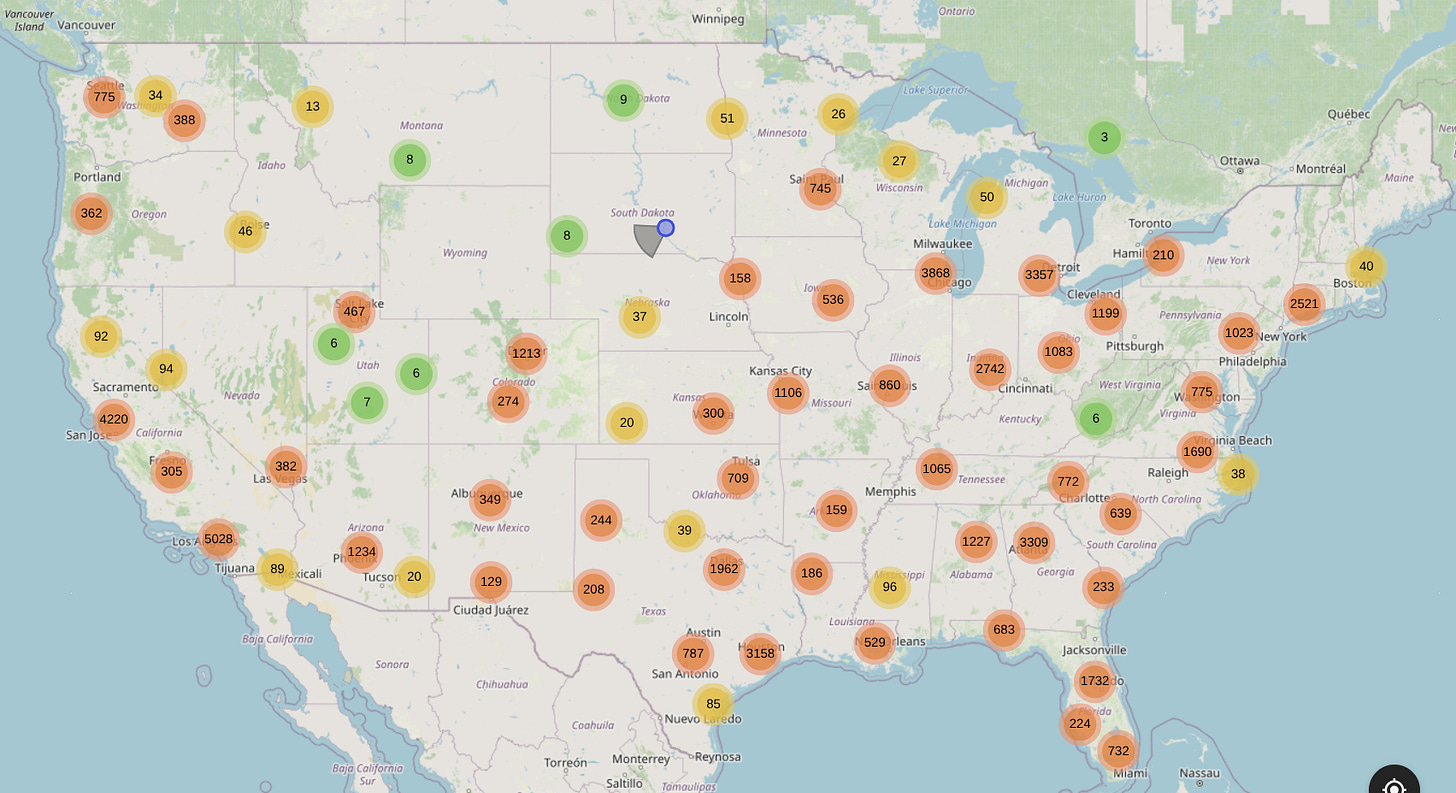
What you can do on deflock.me
- View the live map of Flock cameras in your town or county.
- Have I been flocked?—Has your license plate been looked up in Flock?
- Identify camera models—Most U.S. units are black, teardrop‑shaped, and solar powered, or are attached to traffic lights.
- Contribute sightings—Anyone can upload a photo or location, helping the community keep the database current.
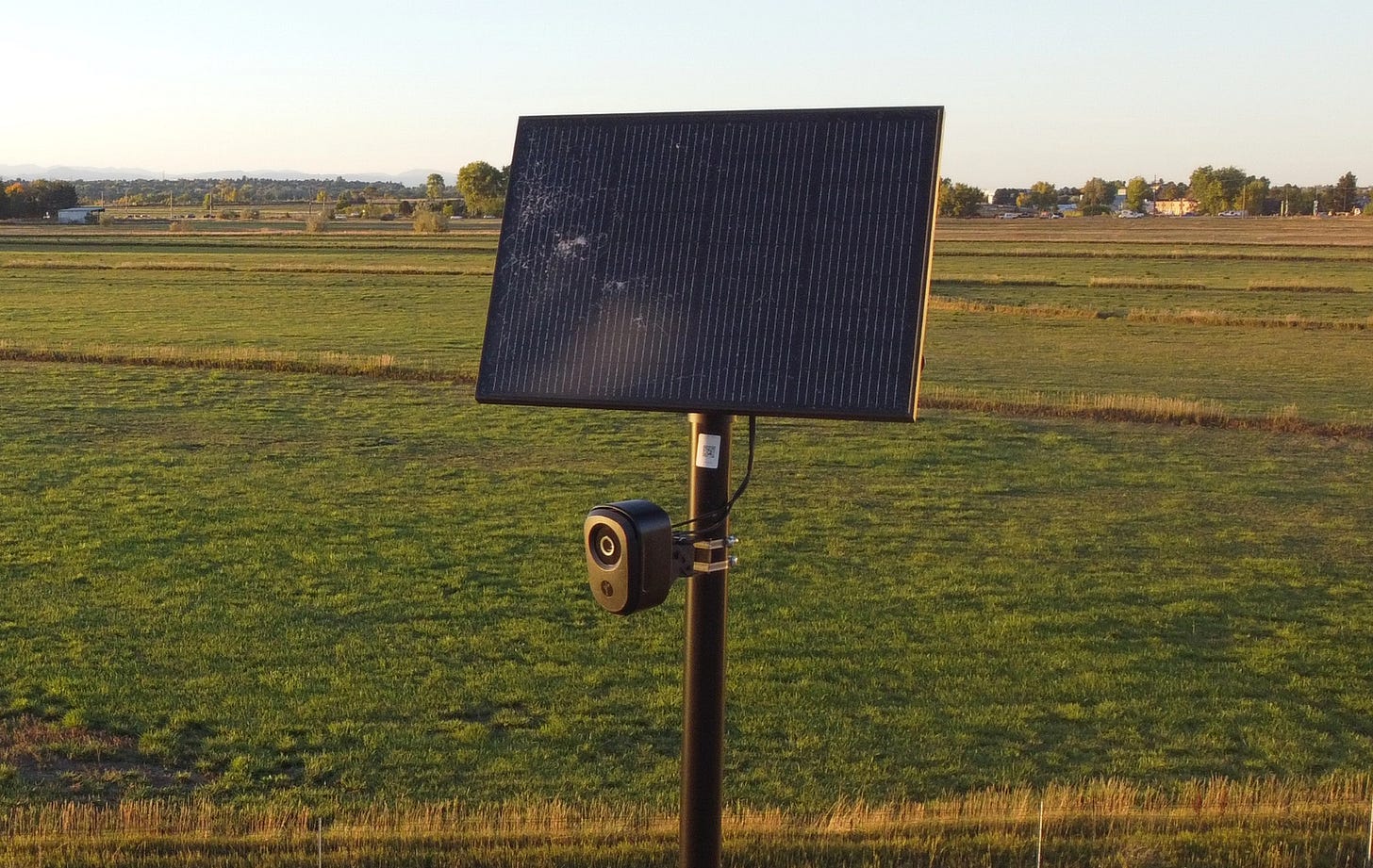
Through the power of the people, we can gain transparency and visibility on mass surveillance.
When one road surveils you, find a better path to travel.
What do you think?
- Take a look at the local area on the map. Is it possible to drive through your town without being spotted by a Flock camera? In many cases it’s infeasible.
- How could a system like this be abused?
- Is there anything we can do?
This is a segment from #TBOT Show Episode 19. Watch the full episode here.

Did you know private and ethical AI models exist?
Join us for our next FREE hands-on webinar: Empowerment with Ethical, Local, and Private AI
📅 This Friday, December 12, at 12 pm CST
LEARN HOW:
- To use a private AI
- To optimize your prompts for maximum effectivness
- How AI models are trained and how they control and censor information
Don’t hand your authority over to AI!

Above’s holiday sale is now on!
Don’t miss incredible savings on our most popular devices, a free month of Above Suite, and more!

Take Back Our Tech Newsletter
Join the newsletter to receive the latest updates in your inbox.