You Will Own No RAM
Just another “you will own nothing and be happy” moment.

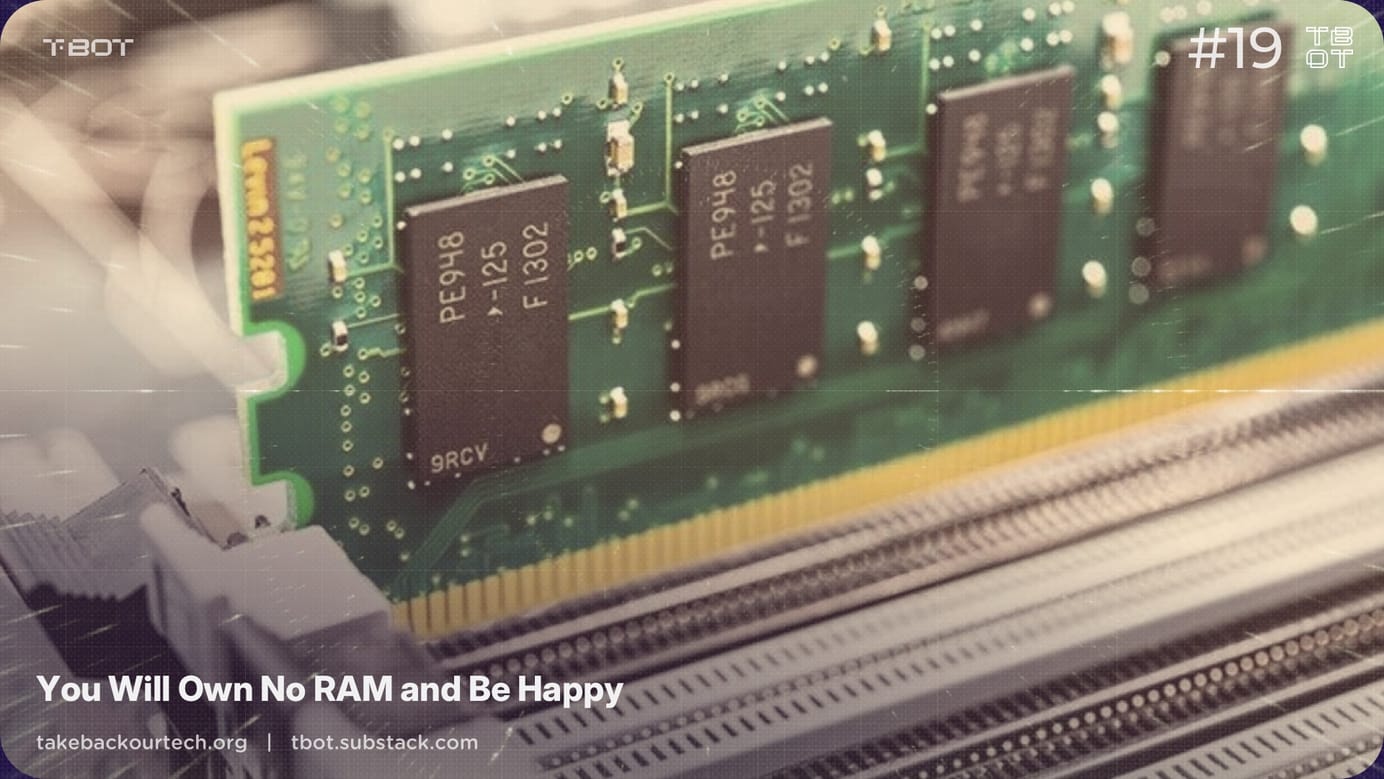
As the holiday season winds down, I’m reminded of a pastime that defined my teenage years: building computers. Like many kids my age, I begged my parents for money to assemble a gaming rig every few years. Unfortunately, that tradition is now over.
All Your RAM Are Belong to Us
The manufacturers that once focused on consumer‑grade components—things like graphics cards, memory modules, and solid‑state drives—are pivoting toward AI data centers instead.
Micron (the maker behind the Crucial brand) announced it will discontinue Crucial products at the end of February 2026.
“The AI‑driven growth in the data center has led to a surge in demand for memory and storage. Micron has made the difficult decision to exit the Crucial consumer business in order to improve supply and support for our larger, strategic customers in faster‑growing segments.”
Micron is not alone; several firms are halting production of NAND and DRAM to instead focus on HBM (High‑Bandwidth Memory), a specialized DRAM designed for AI workloads that sits directly next to GPUs or AI chips in data‑center servers.
Here are some more cases to drive the point:
- Samsung is looking to supply Nvidia with HBM memory at 150,000 wafers per month.
- Meta is planning to spend $72B on AI data centers and servers.
Too many abbreviations? Here’s a quick refresher on the most common forms of memory used today.
- NAND: found in SSDs, flash drives, SD cards, and smartphones. It retains data without power, making it suitable for long‑term storage.
- DRAM: dynamic random‑access memory that loses its contents when power is removed. It’s the volatile memory your computer uses while running.
- HBM: a high‑performance variant of DRAM built for AI, offering much greater bandwidth than conventional DRAM.
Stargate Woes
The shift accelerated with the October announcement of Project Stargate, a $500 billion investment in AI data centers by OpenAI, Oracle, and SoftBank. The deal secured agreements with Samsung and SK Hynix—the two largest memory producers—to supply 900,000 DRAM wafers each month, representing roughly 40% of the world’s DRAM output.
An analysis by Implicator shows the effect clearly: RAM prices doubled by the end of November.
What this means
- Rising component costs—Storage and RAM are expected to stay pricey throughout the next year, making DIY builds increasingly unaffordable.
- Supply locks—Large contracts tied to Project Stargate and other “big tech” initiatives will hoard critical components, limiting what’s left for the consumer market.
The Impacts on Personal Computing
- Inflated prices—Consumers end up paying higher prices for the very hardware that funds AI R&D, a paradox that benefits only the manufacturers.
- Erosion of personal computing—Gaming, local AI experiments, and other compute‑intensive hobbyist activities could suffer dramatically.
- Shift to the cloud—As powerful machines become prohibitively expensive, manufacturers may steer users toward cloud‑based solutions. In that scenario, you don’t own a high‑end PC, instead, you rent AI workloads by the minute from a big tech provider.
Just another “you will own nothing and be happy” moment.
Take Back Your RAM
- Make the AI bubble pop. Avoid overusing cloud-based AI services and software that has caked in AI (AI tools, social networks, and big tech devices).
- AI power and data center demands come mostly from inference (continued use of the AI). The more people who avoid it or use it locally, the less demand there is for data centers.
- Go local with your AI. Use LLM clients like LMStudio or Jan.AI
- Learn more in Above’s latest webinar: Empowerment with Ethical, Local, and Private AI (Available starting December 13)
Subjugation to AI comes from our own complicity and use. Your actions matter.
This is a segment from #TBOT Show Episode 19. Watch the full episode here.

Above’s holiday sale is now on!
Don’t miss incredible savings on our most popular devices, a free month of Above Suite, and more!

Take Back Our Tech Newsletter
Join the newsletter to receive the latest updates in your inbox.