Anti-Drone Tech Hits FIFA World Cup

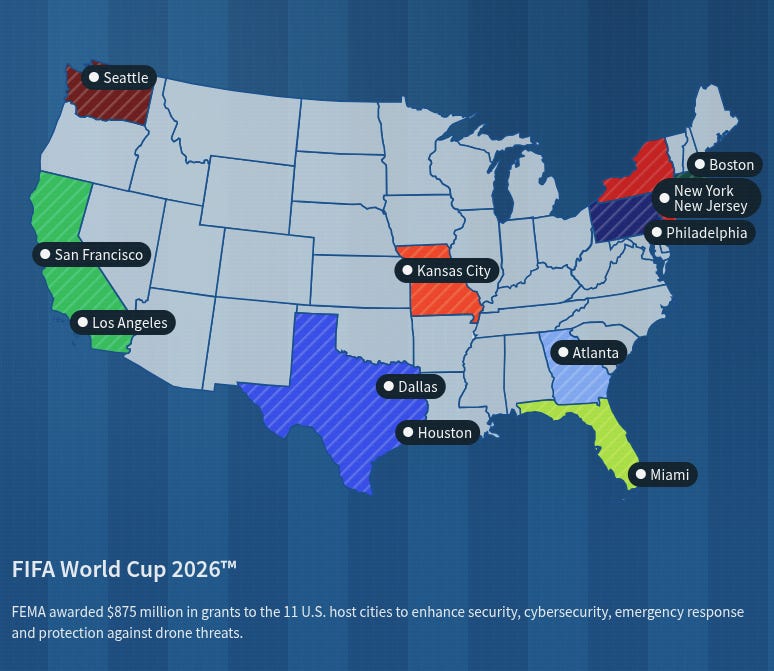
Thanks to the FIFA World Cup, we’re now starting to see the largest drone deployments for public sporting events. For the first time ever, U.S. state- and local-level law enforcement will be operating anti‑drone surveillance, drone‑first responders, and kinetic counter‑drones for World Cup matches in 11 cities.
In May of 2026, FBI Assistant Director Devin Kowalski said, “every public gathering is a drone environment. The public expects and deserves those skies to be watched.”
The legal pretext for this was set up by the National Defense Authorization Act (NDAA), signed into law in December 2025. It included the Safer Skies Act, giving state and local authorities the ability to conduct anti‑drone operations to stop someone else’s drone. To become authorized for anti-drone operations, state and local officials must undergo training during a two-week anti‑drone course taught by the FBI.
Where’s the money coming from? Cities are getting the funding they need. FEMA has already granted almost a billion dollars to U.S. cities, granting them security, cybersecurity, and anti‑drone tech. In January 2026, DHS announced a new office for Unmanned and Counter Aircraft Systems along with $115M in counter‑drone investments.
So with this legal pretext and budget, we’ll be coming face to face with drone tech. Today we’ll look at the anti‑drone solution stack in use in the United States being used to guard public sporting events.
Drone Interception—Ondas SentryCS
First up, you need to be able to identify unknown drones operating within your airspace. SentryCS is perhaps the most popular solution in use, running in 70% of U.S. host states plus Canada and Mexico.
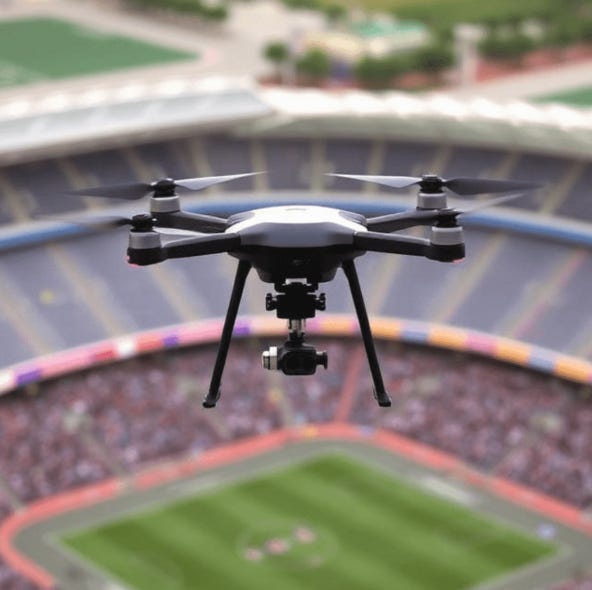
This portable deployable system can be set up in only five minutes. The company claims it can detect drones within six miles within seconds. It listens for drone comms signals and then isolates target drones and their pilots. It’s able to identify serial numbers, the operator’s location, the home location, and where the camera is pointing. The system then tells the target drone to disconnect and takes it over, after which it can be flown to a safe location.
Drone First Responders—Axon Dedrone
Next, you want to get eyes on the situation with your first response drones. Dedrone, acquired by police‑tech giant Axon in 2024, specializes in Drone as First Responder technology. DFR programs dispatch cutting‑edge drones to the site of an emergency, far faster than police can arrive.
Axon partnered with drone company Skydio for its drone first responders. This drone can fly at speeds of 45 mph, has a max flight time of 40 minutes, can transmit at a range of 7.5 miles, and run off of a 5G cellular connection.
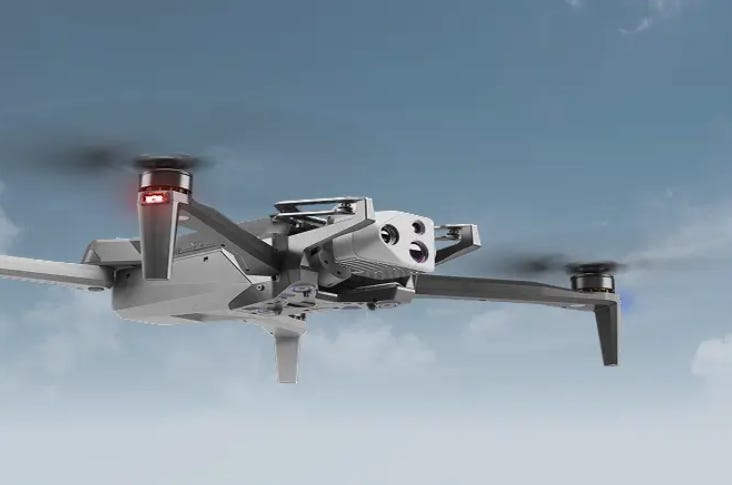
It’s outfitted with six navigation cameras, two video cameras, and even a thermal sensor. It’s also got a telephoto lens that can detect a person at 8,200 feet and read a license plate from 800 feet.
DeDrone enables live video from drones to be collected and integrated into Axon’s evidence capture systems, alongside body‑camera footage. It can also be fused into real‑time crime centers.
All for a price tag of $15,600 per piece. Surveillance never felt so premium.
Kinetic Counter‑Drone Solutions—Fortem
If you can’t take over a drone mid‑flight, then you’ve got to take it down.
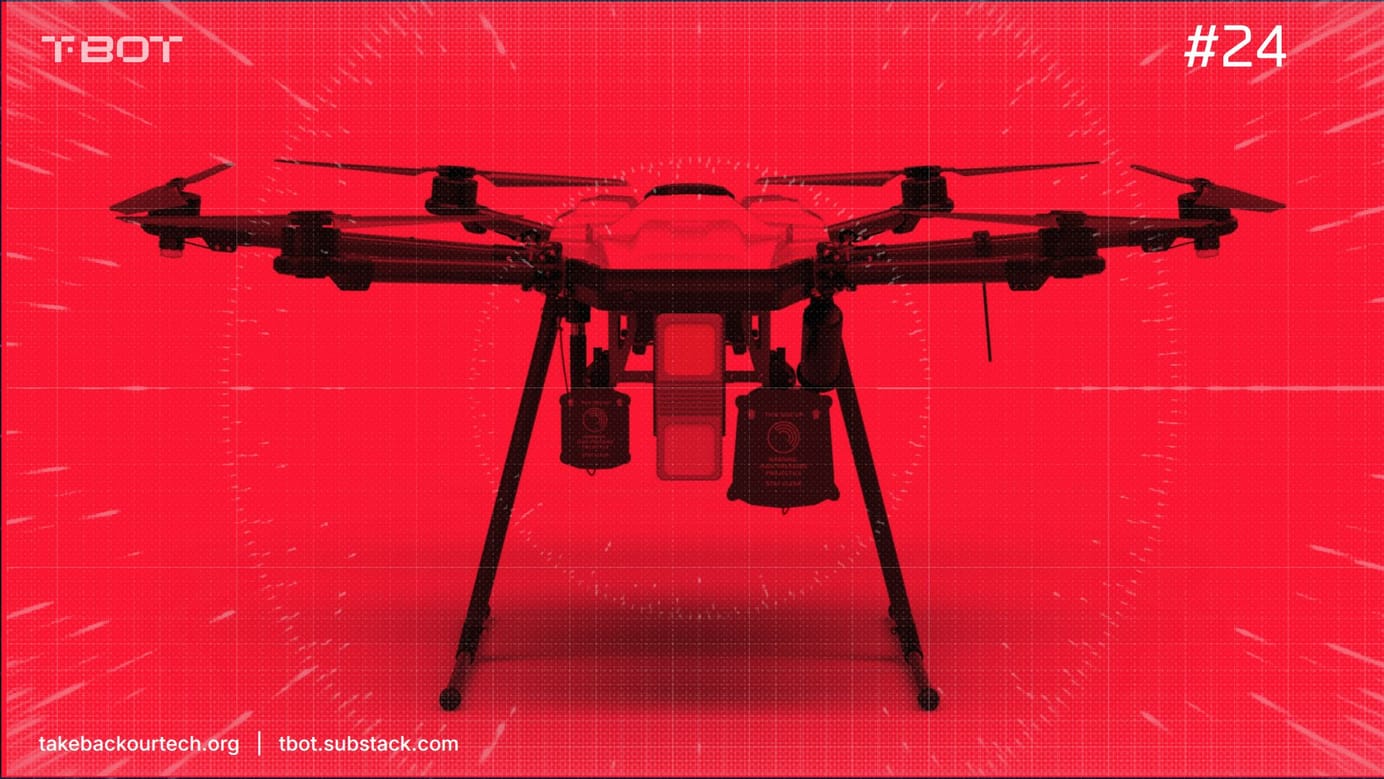
This is where Fortem Technologies’ DroneHunter hits the target; DroneHunter is a drone interceptor hexcopter that captures rogue drones with a net in mid‑air.
It includes Fortem’s special radar systems, which detect and track drones, and command and control software to send the interceptor drones. DroneHunter is 100% autonomous; if a drone is identified, the operator can launch DroneHunter with a single button push.
It finds the target—a second human authorization is used to fire the net on another drone.
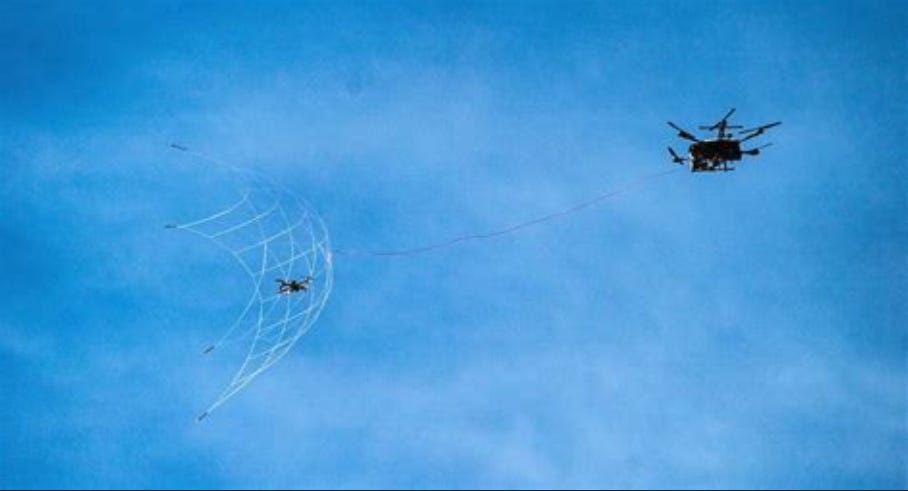
DroneHunters are huge hexcopters, weighing about 40 pounds and able to tow other drones up to 13 lbs. DroneHunter has been upgraded to intercept Russian and Iranian drones, which can travel anywhere from 80 to 115 mph.
Violations
If found flying in restricted airspace, such as a public sporting event, the FAA has been able to fine drone operators up to $75,000 per violation—and can revoke drone and pilot certificates.
Now with Safer Skies, state and local authorities are given authority to seize disable, and destroy drones that they pose as a threat. Repeat offenders can be sent to prison for up to five years, and any felony involving a drone will double the imprisonment or add five years.
Conclusion
For the first time ever, we’ll have large scale anti-drone surveillance and operations at public sporting events. This opens the door to more targeted drone-based law enforcement, and we’ll be coming face to face with drone tech in the years ahead.

Above Share is included in Above Suite. Purchase Above Suite with any new Above Phone or Above Book or purchase it and start using our tools on your current devices!

Take Back Our Tech Newsletter
Join the newsletter to receive the latest updates in your inbox.