UK & Canada's Surveillance Bills
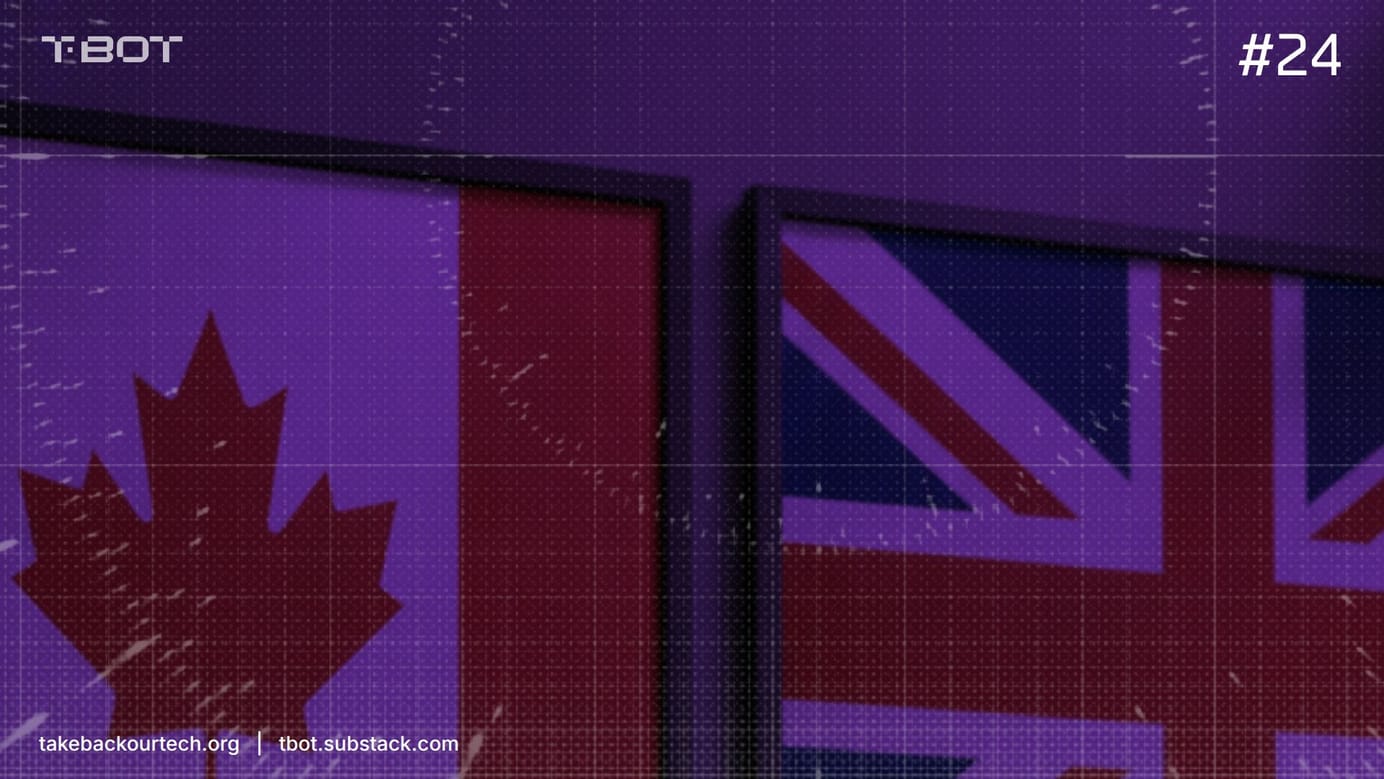
In a special two-for-one, we look at new bills coming out in the UK & Canada.

UK’s Child Social Media Ban
The UK government is planning to ban social media for kids under 16 in a new fact sheet, they lay out the most important changes. The ban will cover platforms like Instagram, YouTube, TikTok, Snapchat, Facebook, and X. It won’t cover messaging apps and will take effect by the start of 2027.
But the problem is that this ban affects far more than children. As a result, all users of these platforms will have to verify their age.
Will people need to have their faces scanned? The fact sheet very cleverly avoids answering that question directly.
They hint that they’ll gather age signals through other means like knowing how long accounts have been open, user credit card info, or linking it to other age verification schemes.
All of this information could be adapted to support a Digital ID scheme. And if not, it could be as simple as a facial recognition check for everyone else.

Although the Office of Communications (OFCOM) has not decided the exact ways you’re meant to verify your age, we already know what’s coming—the facial scan and digital ID kicker. The fact that Digital ID or e-passport has biometrics built in makes it the easiest way to verify.
The rules also have a section addressing VPNs and their plans to do additional research to ensure that the bans cannot be circumvented.
On the bright side, the UK government is investing £3 billion into building 250 youth centres, sports facilities, arts venues, museums, and libraries—all things that may be better for children. Let’s hope these things actually get built.
Canada’s Lawful Access Law
Canada’s Bill C‑22 is one of the most draconian laws we’ve seen, expanding police powers through warrantless access of information and attempting to require backdoors on different services. Under the bill, Canadian police could ask phone and internet service providers if they serve a specific phone, email, or account without needing a warrant.
With just “reasonable suspicion”—the lowest bar of evidence—police can force anyone who “provides services to the public” to provide information on others. This isn’t just tech companies; it’s your grocery store, your doctor, your lawyer, and more.

They’d be forced to hand over any info they have on you simply based on suspicion. Say goodbye to medical and legal privacy.
The second part of the bill is even more staggering. It would require “core providers” to build and maintain the ability to hand over data or intercept communications when lawfully ordered by a ministerial order.
Tech companies, like encrypted messengers and VPN apps, would have to build that capability, and they’d have to retain data they would normally delete—for six months. The company would also have to hide that it’s been given a ministerial order.
Which providers are actually impacted? They still haven’t figured that out; different types of companies can be added to the definition after the bill passes.
These core electronic service providers will be subject to these demands, and the definition of an electronic service is so vague it could extend to your OS. It appears that the intended providers are large telecoms and platforms like Google, but the order can be imposed on any electronic service provider.
Of course many of the measures will be impossible to comply with, especially for companies that make end‑to‑end privacy their whole business.
We’re getting to late‑stage surveillance in Canada—where it’s better that you give almost no real information to any electronic or in‑person provider.
The Above Phone Pixel 10 is here!

We’re excited to introduce four powerful new phones to the Above Phone lineup!
Powered by GrapheneOS and fully de-Googled, the Above Phone Pixel 10 is carefully configured to make everyday communication, browsing, and data storage simpler, safer, and more efficient.

Take Back Our Tech Newsletter
Join the newsletter to receive the latest updates in your inbox.